

EVA AIOps collection layer
All your data, one entry point
EVA Collector captures telemetry from any source — servers, network, applications, containers and clouds — and delivers it normalized and encrypted to EVA AIOps.
Collection mechanisms
The right method for every component
| Mechanism | Standards and protocols | Coverage |
|---|---|---|
| Agent-based | Lightweight agent with eBPF (a Linux kernel technology for low-overhead system observability) or equivalent | Physical and virtual servers and container nodes: metrics, logs, events and traces |
| Agentless | SNMP v1/v2c/v3 (polling and traps), SSH, WMI and Syslog | Network and security devices, storage, printers, UPS units, precision air conditioning, legacy environments and any SNMP device |
| Network flows | NetFlow, sFlow and IPFIX | Traffic, bandwidth and conversations on your links |
| Open standards | OpenTelemetry (OTLP) and Prometheus / OpenMetrics exporters | Applications, Kubernetes and databases |
| APIs and files | Cloud and vendor APIs, inbound webhooks and log files | Azure, OCI, AWS, vendor consoles and customer applications |
Getting started
From installation to first data
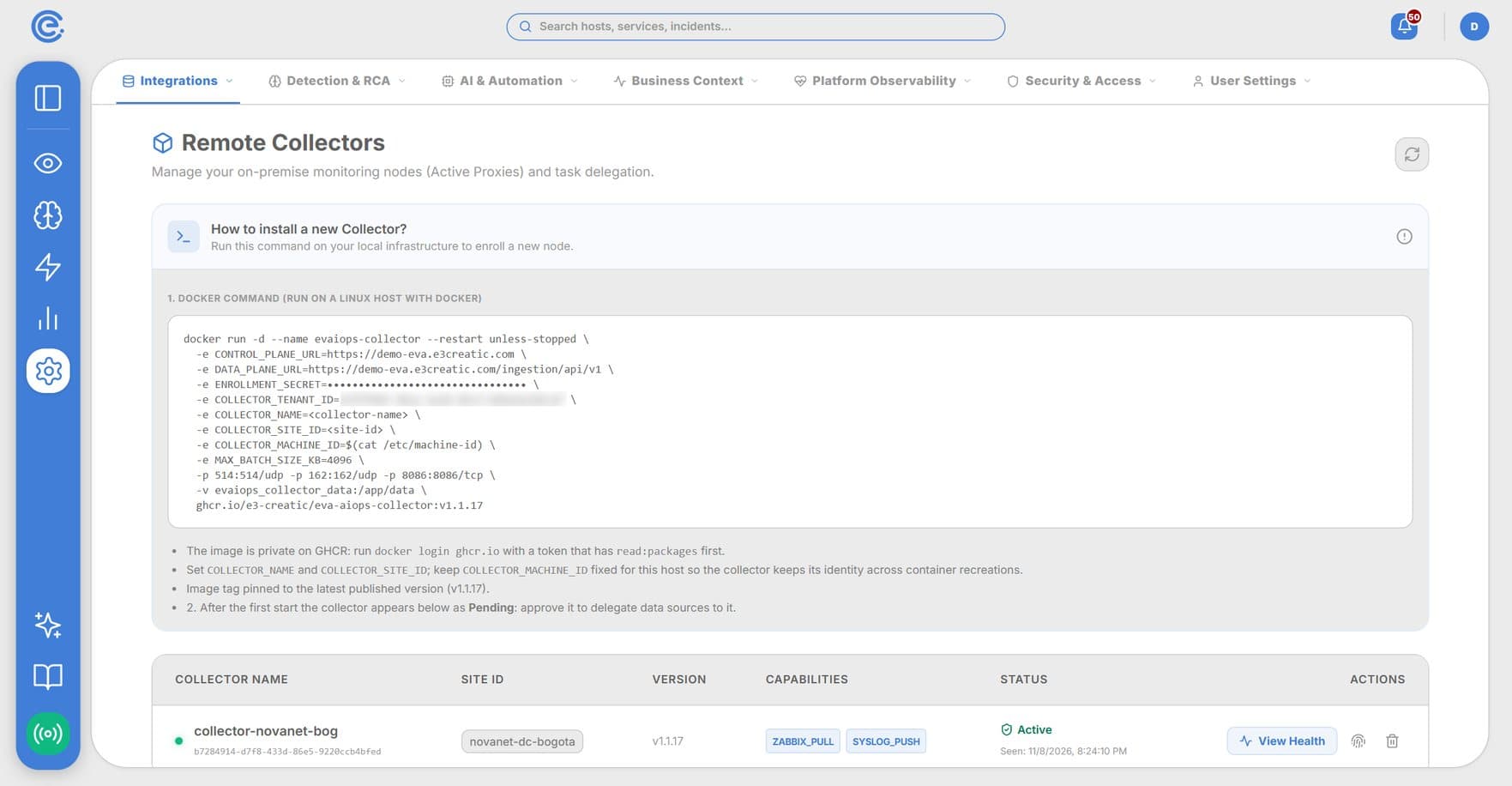
Step 1 · Install
One container on your network
The console generates a ready Docker command with the enrollment secret.
Step 2 · Approve
Controlled enrollment
The administrator approves the collector and the platform issues a renewable token.
Step 3 · Collect
Sources and receivers
Assign sources, Syslog and trap receivers, flows and agents from the central console.
Step 4 · Send
Encrypted and resilient
Outbound HTTPS connections only, with mTLS; local buffer of up to 100,000 events during outages.
Benefits
Designed to run on your network
Installs in minutes
No inbound firewall ports to open: the collector starts the encrypted connection to EVA.
Secure at the source
Enrollment secret, administrator approval, renewable token, TLS 1.2/1.3 and mTLS. Optional IPsec VPN.
No data loss
Persistent local buffer, delta-only transmission and fallback URLs.
Centrally managed
Status, health, revocation and configuration of every collector from the EVA console. It also runs remote diagnostics and synthetic tests.